

Recording clean dialogue outdoors is much harder than recording in a quiet room. A microphone may sound excellent indoors but struggle as soon as wind, traffic, crowds and long distances enter the picture.
For travel videos, documentaries, street interviews and outdoor filmmaking, the best wireless mic is not simply the model with the longest advertised range. Wind protection, connection reliability, local backup recording and battery life often matter more in real-world use.
Understanding these factors before comparing specific systems makes it easier to choose equipment that will still deliver usable audio when conditions are less than ideal.
Wind protection should come first
Wind is one of the most common reasons outdoor dialogue becomes unusable.
A microphone capsule reacts to moving air, producing low-frequency rumble and sudden bursts that can overwhelm speech. Even a gentle breeze can become distracting when the microphone is clipped high on a shirt or jacket.
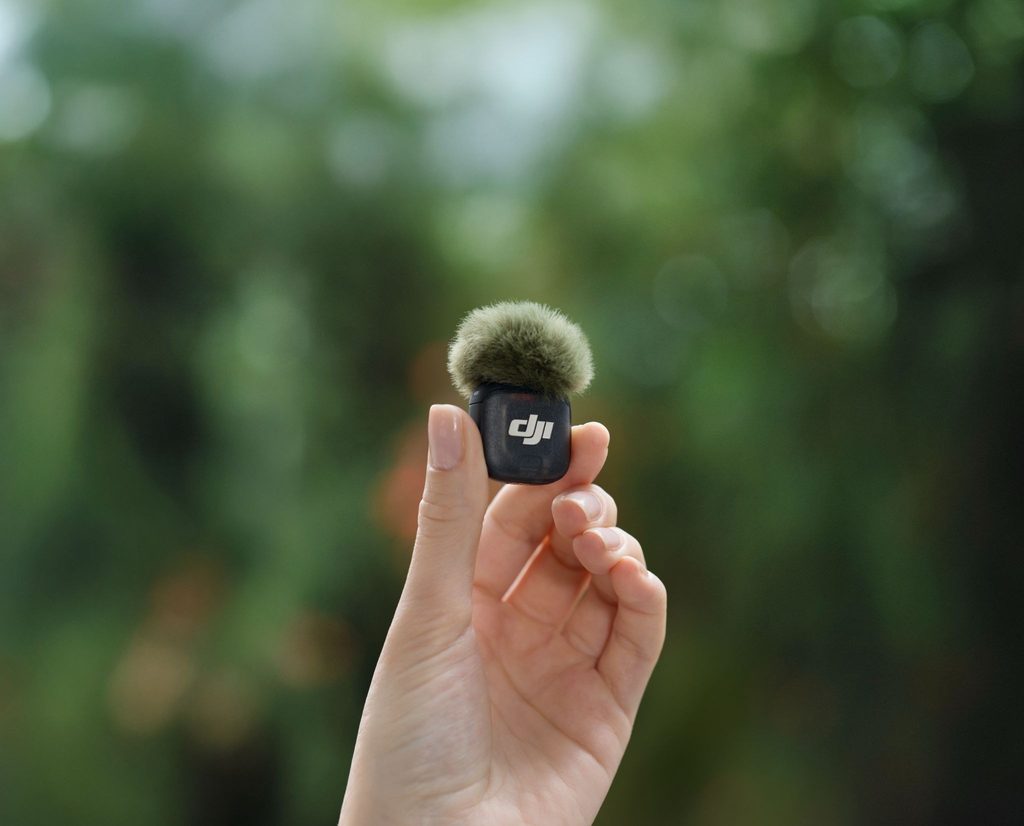
For outdoor recording, a furry windscreen is one of the simplest and most effective accessories. It physically reduces the force of air reaching the microphone capsule. Small foam covers can help indoors or in very light air movement, but stronger wind normally requires more substantial protection.
Placement also matters. A microphone positioned directly in the wind will have a harder job than one protected slightly by clothing or the speaker’s body.
Electronic noise reduction can help with steady background sound, but it should not be treated as a replacement for physical wind protection. Aggressive processing may also affect the natural quality of a voice. In windy conditions, it is usually better to reduce the problem before it reaches the microphone.
Advertised range is not the same as practical range
Wireless microphone manufacturers often publish impressive maximum transmission distances. These figures are useful for comparison, but they are normally measured with a clear line of sight and minimal interference.
Outdoor filming can be very different.
Trees, buildings, vehicles, crowds and even the speaker’s body can interfere with the radio path. Urban locations may also contain large numbers of Wi-Fi and Bluetooth devices using similar frequencies.
For an interview where the subject is five metres from the camera, a theoretical range of several hundred metres is not especially important. Reliability at normal working distances matters more.
Long range becomes genuinely useful for sports, documentary work, property videos or scenes where the subject moves far away from the camera.
Whatever the specification says, try to keep the transmitter and receiver reasonably unobstructed. If a presenter turns their back and their body sits directly between the transmitter and receiver, signal performance may decrease considerably.
Backup recording is valuable when a take cannot be repeated
Radio transmission is only one part of a wireless system. More advanced transmitters can also record audio internally.
This means that even if the wireless link briefly drops out, the original audio can still exist on the transmitter.
For casual social content, this may not be essential. If you are filming a wedding interview, documentary conversation or one-time event, it can be extremely valuable.
32-bit float internal recording adds another layer of flexibility. It provides a very wide usable dynamic range, making it easier to recover audio when a person suddenly becomes much louder or quieter than expected.
It does not mean microphone placement and gain no longer matter. Wind distortion or clothing rubbing against the microphone cannot simply be repaired by using 32-bit float. But it provides useful protection against level problems.
A safety track is different from internal recording. It normally creates another version of the incoming audio at a lower level on the receiving device. That can help with clipping, but it still depends on the wireless transmission reaching the receiver successfully.
Think about battery life as a complete system
Outdoor filming days are often longer than the final video suggests.
A five-minute travel film may require hours of walking, waiting and repeated takes. For interviews at an event, a microphone system may remain powered throughout most of the day.
Check the runtime of both transmitter and receiver, because either one can end the recording session.
A charging case can be particularly useful outdoors. Instead of carrying loose charging cables and finding a power socket between every session, the transmitters and receiver can recharge whenever they are returned to the case.
For multi-day travel, total runtime with the charging case may be more relevant than the runtime of one transmitter alone.
RØDE Wireless PRO
For filmmakers who want extensive backup features, RØDE Wireless PRO remains a strong outdoor option.
The dual-channel system has a quoted transmission range of up to 260 metres line of sight and provides 32-bit float onboard recording. Each transmitter includes 32GB of internal storage for more than 40 hours of recording. Timecode, headphone monitoring and intelligent GainAssist are also included.
RØDE supplies the kit with two Lavalier II microphones and furry windshields, which is useful for interviews where the filmmaker prefers to hide a small lavalier rather than wear the transmitter itself visibly on clothing.
Battery life is rated at up to seven hours per unit, and a charging case is included.
It is a well-equipped system for documentary and professional video work, although creators who prioritise a smaller, lighter everyday kit may not need all of its production features.
DJI Mic Mini 2S for lightweight outdoor content and local backup
For travel vloggers and creators who want to minimise equipment without giving up local backup recording, DJI Mic Mini 2S is a particularly strong fit for outdoor content.
The transmitter weighs about 12g excluding the magnetic clip and magnet, making it easy to clip onto light clothing. A furry windscreen is included, and DJI also provides two levels of AI noise cancellation. Outdoors, however, the windscreen should still be treated as the first line of defence against gusts rather than relying on processing alone.
With the DJI Mic Mini 2S Receiver, DJI quotes a maximum transmission distance of up to 400 metres in an open, unobstructed and interference-free environment. This should be treated as an ideal-condition maximum: buildings, crowds, the speaker’s body and busy radio environments can all reduce practical range.
Unlike Mic Mini 2, Mini 2S can also record locally in 24-bit or 32-bit float. Its transmitter has approximately 14.5GB of built-in storage, supporting about 28 hours of 24-bit or 22 hours of 32-bit float recording. That makes the local file a useful safeguard if the wireless link drops during a take.
Battery endurance remains strong for travel days. DJI rates the Mini 2S transmitter for up to 11 hours, the receiver for up to 10 hours, and the charging-case system for up to 40 hours under its test conditions. For outdoor creators, the combination of low weight, physical wind protection, local 32-bit float backup and long operating time makes Mini 2S a more complete lightweight option.
DJI Mic 3 for more complex outdoor productions
DJI Mic 3 is the more suitable option when an outdoor shoot needs timecode, more advanced backup options or a multi-camera production workflow.
The transmitters support both 24-bit and 32-bit float internal recording. DJI specifies up to 43 hours of single-file 32-bit float recording or 21.5 hours in dual-file 32-bit float mode.
That makes it possible to send audio wirelessly to the camera while retaining a high-dynamic-range local recording as an additional source for post-production.
Wireless performance is also designed for more demanding environments. Mic 3 automatically works across 2.4GHz and 5GHz bands, with DJI quoting up to 400 metres in open, interference-free conditions. More interestingly, DJI also publishes an 80-metre result from a laboratory-simulated high-interference environment with clear audio and no packet loss.
Neither figure guarantees performance at a particular outdoor location, but publishing a separate interference test provides useful context beyond the maximum line-of-sight number.
Mic 3 also includes two levels of noise cancellation, Adaptive Gain Control and timecode support. The transmitter is rated for up to eight hours and the receiver for up to ten hours, while the charging case extends total operating time to around 28 hours in DJI’s tests.
For documentary interviews, outdoor events and video productions where audio needs to be synchronised with several cameras, those features make Mic 3 a more complete choice than a basic wireless kit.
Which system makes the most sense outdoors?
For occasional travel videos and street content, start with wind protection and portability. DJI Mic Mini 2S is particularly convenient when you want a very small transmitter but still want 32-bit float local backup recording for takes that cannot easily be repeated.
RØDE Wireless PRO makes sense for filmmakers who want a complete professional package with included lavalier microphones, long internal recording and timecode.
DJI Mic 3 is particularly compelling when you want the compactness of a creator-focused system but also need 32-bit float backup recording, strong wireless flexibility and production features such as timecode.
Whichever system you choose, do not buy on transmission distance alone. Outdoors, a properly fitted windscreen, sensible transmitter placement and a local backup recording can save far more footage than an extra hundred metres on a specification sheet.
