

Choosing a first camera drone can be difficult because beginners and content creators do not always need the same features. A new pilot may care most about simple controls, portability and confidence in the air. A creator may put more emphasis on image quality, vertical video, subject tracking and the ability to shoot in different lighting conditions.
For Canadian users, weight is also worth considering. Drones under 250 g do not need to be registered with Transport Canada, and pilots do not need a drone pilot certificate to fly them. The rules for microdrones still apply, and pilots must always fly safely and respect restricted airspace.
That makes compact models especially appealing for beginners and travellers. More advanced creators may still prefer a larger drone when camera flexibility matters more than minimum weight.
Here are some of the strongest options for different types of users.
DJI Lito Series: the best first drone for beginners
For a first-time buyer who wants to learn real camera-drone flying, DJI Lito 1 is the strongest starting point in this list. It uses a conventional RC controller, so a beginner can learn stick control and framing while still benefiting from useful flight assistance.
In standard configuration, Lito 1 stays under 249 g. Its 1/2-inch CMOS camera captures 48 MP photos and 4K/60fps video, with 4K/100fps slow motion and 2.7K vertical video.
Omnidirectional obstacle sensing is a major advantage for beginners, while ActiveTrack, QuickShots and MasterShots can handle subject following and preset camera moves as the pilot builds confidence. Rated flight time is up to 36 minutes with the standard battery.
For beginners who already know they want more room for low-light work and colour grading, Lito X1 is the premium step-up in the same series. It also stays under 249 g in standard configuration, but moves to a 1/1.3-inch 48 MP f/1.7 camera with 4K/60fps HDR, 10-bit D-Log M, forward-facing LiDAR and 42 GB of internal storage.
Best for: first-time pilots who want a proper camera drone, travel and family use, and beginners who want room to grow without moving into a heavier aircraft class.
DJI Flip: an easy choice for casual creators and automated filming
DJI Flip is better suited to casual creators who want quick, automated aerial content and the reassurance of a protected propeller design, rather than a more conventional first-drone learning experience.
It weighs under 249 g and uses a foldable full-coverage propeller guard. That design gives the aircraft a more protected structure around the propellers, which can help new users feel more comfortable during their first flights. It also features a 1/1.3-inch sensor capable of 48 MP photos and 4K/60fps HDR video.
Flip is especially useful for vloggers and social creators. It supports intelligent shooting tools such as subject tracking and automated flight movements, so a creator does not always need to manually plan every camera move.
Its compact size also works well for Canadian road trips, cottage weekends and city-to-nature travel. A creator can keep it in a small bag rather than carrying a large dedicated drone case.
Best for: casual vloggers, family trips, self-filming and creators who prioritize easy automated shots and full-coverage propeller protection.
DJI Mini 5 Pro: the best all-round choice for travel creators
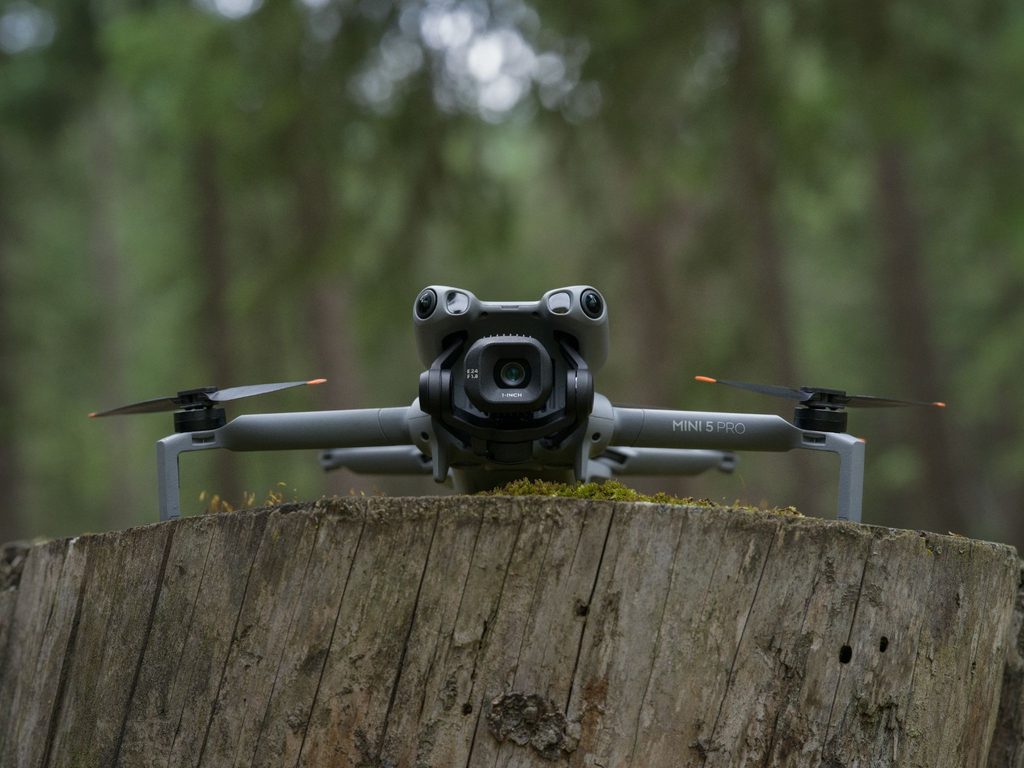
For someone who wants a compact drone but takes photography and video more seriously, DJI Mini 5 Pro is one of the most attractive choices in the current Canadian range. DJI positions it as an advanced 1-inch-sensor mini camera drone.
The larger sensor makes it particularly interesting for travel photographers. Canadian landscapes often involve challenging light, from bright snow to forest shadows and late-evening skies. A more capable imaging system gives creators extra flexibility in these conditions.
The small format is another major advantage. A travel creator may already carry a mirrorless camera, lenses, microphone and laptop. Keeping the aircraft around the 249 g category makes the complete kit easier to manage.
Mini 5 Pro therefore sits in a useful middle ground. It is compact enough for frequent travel while offering a camera aimed at creators who want more than casual clips.
Best for: travel creators, photographers, YouTubers and users who want a lightweight drone with more room to grow.
DJI Mini 4 Pro: a balanced option for photo, video and social content
Mini 4 Pro remains a very capable option for creators who want a mature mix of portability and creative tools.
It weighs under 249 g with its standard battery and uses a 1/1.3-inch 48 MP sensor. It can shoot JPEG and DNG RAW photos and record 4K video at up to 60fps for normal footage or 100fps for slow motion. It also includes omnidirectional obstacle sensing.
For content creators, one of its useful features is true vertical shooting. This allows the camera to rotate for portrait-oriented content rather than simply cropping a horizontal frame later.
That makes Mini 4 Pro particularly convenient for creators who produce both YouTube videos and short-form social content.
For travel photography in daylight, its camera offers plenty of flexibility. RAW support also gives photographers more control over colour, highlights and shadows in editing.
Best for: social creators, travel photographers and users who want a compact, well-rounded creative tool.
What should beginners actually look for?
A first-time buyer can easily focus too much on resolution or maximum range. In practice, other features often have a bigger effect on the experience.
Weight is important because a lighter drone is easier to carry and may also simplify regulatory requirements in Canada. Flight assistance matters because smooth hovering and automated shooting tools reduce the amount of manual control required during early flights.
Obstacle sensing can also be useful, although it should never replace careful flying. No detection system can identify every object in every condition.
This is where Lito 1 makes sense as a first drone. It combines omnidirectional obstacle sensing with ActiveTrack, QuickShots and MasterShots, giving new pilots useful assistance while they learn stick control, framing and smooth camera movement.
Battery strategy matters too. One extra battery often improves a travel setup more than chasing a few extra minutes of maximum rated flight time. It allows the creator to film at a second location without waiting for a recharge.
DJI Air 3S: a stronger option for serious content creators
Not every creator needs to remain under 250 g.
DJI Air 3S weighs 724 g and takes a different approach by offering two cameras. The main camera has a 1-inch 50 MP sensor with a 24 mm equivalent lens. The second uses a 1/1.3-inch 48 MP sensor with a 70 mm equivalent lens. Both can shoot JPEG and DNG RAW.
The second focal length is valuable for photography and video because it changes composition without forcing the aircraft to move much closer to the subject.
A wide view works well for lakes, mountains and city skylines. The 70 mm equivalent camera can isolate a cabin, compress mountain layers or create a more focused shot of a landmark.
Air 3S also offers up to 45 minutes of rated flight time under DJI’s test conditions.
For a content creator who plans shoots rather than simply carrying a drone everywhere, the extra camera flexibility can justify moving into a larger aircraft category.
Best for: serious YouTube creators, landscape photographers and filmmakers who value multiple focal lengths.
Which drone is best for Canadian travel?
For lightweight travel, DJI Lito 1, Lito X1, Flip, Mini 4 Pro and Mini 5 Pro all have an important advantage because they sit below or around the 250 g threshold depending on configuration.
That can make them attractive for road trips through British Columbia, coastal travel in the Maritimes or weekend trips in Ontario and Quebec.
However, being under 250 g does not mean pilots can fly anywhere. Transport Canada still requires microdrone pilots to operate safely, avoid restricted areas and respect other applicable laws. Emergency sites and certain restricted airspace remain off limits without the required authorisation.
Always check the location before taking off.
Which drone is best for YouTube beginners?
For someone buying a first conventional camera drone, DJI Lito 1 is the strongest starting point. In standard configuration it stays under 249 g, and omnidirectional obstacle sensing, ActiveTrack, QuickShots and MasterShots give a new pilot useful assistance while learning real flight control and framing.
DJI Flip may still be the better fit for someone who values quick automated filming, a full-coverage propeller guard and casual self-recording more than learning on a conventional camera-drone layout.
A beginner with stronger photography or video ambitions can step up to Lito X1, Mini 4 Pro or Mini 5 Pro. Lito X1 adds a 1/1.3-inch 48 MP f/1.7 camera, 4K/60fps HDR, 10-bit D-Log M, forward-facing LiDAR and 42 GB of internal storage; the Mini models remain especially attractive for true vertical shooting and broader creator-focused camera features.
There is no need for every beginner to buy the simplest model. Lito 1 is the clearest default for a first camera drone, while Lito X1, Mini 4 Pro and Mini 5 Pro make more sense when camera ambitions already justify the step up.
Which drone is best for more advanced creators?
For a creator who values maximum portability, Mini 5 Pro is the more natural fit. It keeps the travel-friendly concept while putting greater emphasis on image quality.
For someone who wants more control over composition, Air 3S has a different strength. Its 24 mm and 70 mm equivalent cameras allow two distinct visual styles without changing aircraft.
This makes the two models complementary rather than direct replacements for each other.
Final verdict
DJI Lito 1 is the strongest first-drone recommendation for most beginners in Canada. In standard configuration it stays under 249 g, uses a 1/2-inch 48 MP camera, offers omnidirectional obstacle sensing and supports ActiveTrack, QuickShots and MasterShots. Lito X1 is the premium step-up for beginners who want a 1/1.3-inch 48 MP f/1.7 camera, 10-bit D-Log M, forward-facing LiDAR and 42 GB of internal storage.
DJI Mini 4 Pro is an excellent balanced choice for creators who want photography, vertical video and advanced flight features in a sub-250 g format.
DJI Mini 5 Pro is the stronger fit for travel creators who place greater emphasis on camera performance while still wanting a very compact aircraft.
DJI Air 3S makes the most sense for more serious photographers and filmmakers who value two focal lengths and do not mind moving into a larger drone category.
DJI Flip remains an appealing alternative for casual creators who prioritize a full-coverage propeller guard and automated content capture. For most beginners in Canada, Lito 1 is the clearest first camera drone; for content creators, the better choice depends on whether portability, image quality or compositional flexibility matters most.
