

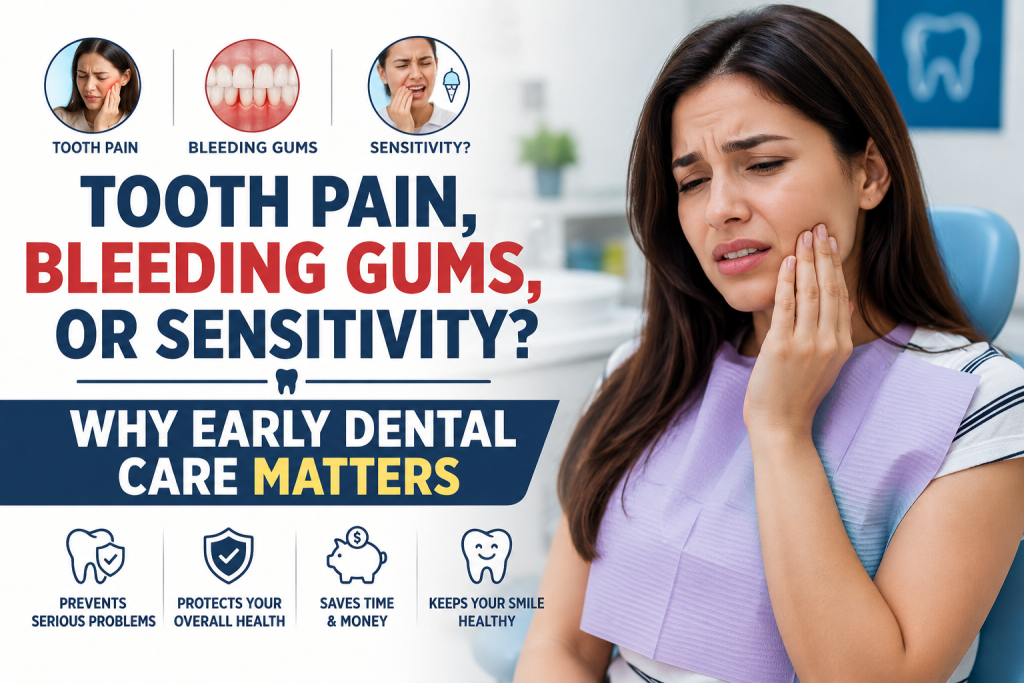
Most people who really need dental care early, the most, are not dodging the dentist because of fear or sheer laziness. It’s more like, they simply do not think anything is wrong. Like their gums have been bleeding after brushing for two years , and it still feels “normal” to them. Their teeth ache with coffee. One side of their mouth carries most of the chewing load. These are not dramatic symptoms. They are quiet, consistent, and utterly normalized — woven so seamlessly into daily life that they no longer register as problems. That normalization is exactly what makes them dangerous.
When “It’s Always Been Like This” Becomes the Problem
There is a significant clinical difference between a symptom that is stable and one that is harmless. Patients routinely conflate the two. “My teeth have always been sensitive to cold” or “I bleed when I floss but only on one side” — these are presented not as complaints but as biographical facts, the way someone might describe their eye color. What they actually describe is a chronic condition that has gone unaddressed long enough to feel constitutional.
Consistency does not equal safety. A slow leak in a foundation is consistent. It is not harmless.
The goal of this article is not to generate alarm. It is to offer something more useful: a framework for distinguishing your actual oral health baseline from the one you have adapted to. That distinction, made early, is the difference between a straightforward clinical conversation and an expensive course of restorative treatment.
Forces That Make Symptoms Feel Normal
Gradual Onset Masks the Shift
Gingivitis, enamel wear, and early-stage decay all have this one kind of same trait: it creeps in slowly. There’s almost never that clean moment where “everything” suddenly flipped. The gum tissue pulls back in tiny fractions of a millimeter across months, like, pretty quietly. Enamel thins imperceptibly. Sensitivity deepens so gradually that the brain recalibrates its threshold for “normal” faster than the tissue deteriorates.
This is not a failure of attention. It is a feature of human adaptation — the same mechanism that allows people to tolerate worsening back pain or poor sleep without a clear crisis point. Patients often accurately recall that a symptom was not always present, then rationalize the change rather than investigate it.
Home Care Advice Creates a False Sense of Control
Switching to a sensitivity toothpaste, downgrading to a softer brush, or adding an antiseptic rinse — these are reasonable responses to mild symptoms, and they frequently reduce discomfort. That is precisely the problem.
Sensitivity toothpastes temporarily occlude dentinal tubules — the microscopic channels that transmit sensation to the nerve. They do not address enamel loss. They do not reverse gum recession. They manage the signal, without really touching the source, exactly. A patient who has muted their sensitivity with an over the counter product has not actually resolved the condition; they have made it quieter and so easier to ignore, basically. And yes, diligent home care is genuinely valuable too. It was never designed to diagnose or treat structural deterioration.
What Years of Tolerance Actually Cost
Clinically, the disease progression model is concrete. Gingivitis, sort of inflammation that stays in the gum tissue, is completely reversible if you get a professional cleaning. But if it is left alone, the bacteria can seep further under the gumline, and that can set off periodontitis, which is not reversible. It is managed. Bone loss accompanying advanced periodontitis does not regenerate without surgical intervention, and often not even then.
The same logic applies to sensitivity. Enamel erosion exposing dentin is a structural problem. Dentin exposure advancing to pulp involvement becomes an endodontic problem — a root canal, or in compromised cases, an extraction. These are not worst-case scenarios constructed to frighten. They are the routine, documented endpoints of symptoms present years before a patient arrives in crisis.
Financially, framing this as “a cleaning costs less than a root canal” understates the real arithmetic. Late-stage treatment rarely involves one procedure. Periodontal therapy precedes bone grafting, which precedes implant placement, which requires a crown. Cost compounds across appointments, recovery periods, and time away from work. The clinical window that makes tooth pain treatment or bleeding gums treatment simple and conservative does not stay open indefinitely.
In daily life, the cost is already being paid. Patients who call their symptoms manageable are managing constantly — ordering drinks without ice, cutting food smaller, avoiding one side of the mouth entirely. These behavioral workarounds are not evidence of tolerance. They are evidence of how completely a symptom has restructured daily life.
How to Audit Your Own Baseline
The Three Questions a Dentist Would Ask
These are not substitutes for a clinical exam. They are the intake flags that shift a symptom from incidental to patterned:
- Duration: Has this symptom been continuously present for more than four to six weeks?
- Change: Has anything shifted — frequency, intensity, or specific triggers — even slightly?
- Compensation: Have you altered any eating, drinking, or hygiene behavior specifically to avoid provoking it?
One “yes” is not a crisis. It is a signal that the symptom has a pattern — and patterns have identifiable causes that, caught early, are almost always treatable through conservative means. This mirrors the triage logic used during comprehensive exams at practices built around early dental care.
Clinically healthy gums do not bleed when you brush as usual— not sometimes , not just on one side, not only after you’ve been a bit inconsistent with flossing. Healthy gum tissue should not start bleeding just from normal mechanical contact. If temperature sensitivity feels sharp , hangs around past a few seconds, or shows up in a predictable way every time, that’s not some cute quirk of physiology. It is a clinical finding.
For patients who maintain meticulous hygiene and still experience these symptoms, that diligence is clarifying, not irrelevant. If the cause were behavioral, consistent home care would have resolved it. When it has not, the driver is structural or systemic — and requires professional evaluation. This is exactly the patient for whom the clinical picture is most time-sensitive, because the absence of obvious neglect can mask how far a structural problem has progressed.
What Early Care Looks Like at Promise Family Dental
The patient who recognizes their own normalization pattern is not arriving in crisis. They are arriving with a question: is what I have been living with actually a problem?
At Promise Family Dental, that conversation begins with symptom history — how long symptoms have been present, what the patient has tried, and what they have stopped doing because of discomfort. That behavioral history is diagnostic. It tells a clinician how embedded the compensation pattern has become and calibrates the urgency of any recommended tooth pain treatment or bleeding gums treatment.
Diagnostic imaging along with a full periodontal review helps check if what is actually being felt matches up with any measurable shifts in tissue, bone level, or something like structural compromise. Results are shared in plain terms, no jargon, no pressure. What you get is clarity, basically a specific evidence-based response about whether the usual starting baseline means treatment now , or instead a structured monitoring plan, or even a small preventive change in home care.
For most patients at this point, the next step is usually conservative care that is non-invasive. The clinical window is still open. Working with a trusted dentist in Suffern NY means accessing exactly this kind of precise, low-intervention care before that window closes.
Your Baseline Was Never Supposed to Include Pain
Tooth sensitivity , bleeding gums, and that chronic tooth discomfort… those arent really personality traits. More like clinical findings , and honestly the sooner they get looked at the more simple and less expensive the fix tends to be. Promise Family Dental brings together Dr. Jacob John and Dr. Edsel Tarife, each with over two decades of clinical experience, to provide careful, evidence based care across Suffern and Rockland County. Every treatment plan is built on an exact diagnosis, straightforward conversation , and outcomes that last. If something inside your mouth has felt a little “off” for longer than you can say you clearly remember, well that little cue is really all you need.
Frequently Asked Questions
- How long does a symptom need to be present before it warrants professional evaluation?
Any symptom continuously present for four to six weeks — or that has changed in intensity, frequency, or triggers — has moved from incidental to patterned. Waiting for pain to worsen is not a useful threshold. By the time discomfort becomes significant, the condition has typically progressed well beyond its most treatable stage.
- If sensitivity toothpaste controls my discomfort, has the underlying problem resolved?
No. Sensitivity toothpastes block the microscopic channels in dentin that transmit sensation to the nerve. They reduce the signal, not the source. Enamel erosion, gum recession, or early decay continues to progress regardless. Over-the-counter management is a short-term measure, not a substitute for professional evaluation.
- Is it possible to have significant dental disease with no obvious pain?
Yes — and this is the point patients most consistently underestimate. Gingivitis causes no pain in most patients. Early enamel erosion is frequently painless. Bone loss from periodontitis can advance substantially before discomfort appears. Pain is a late-stage symptom. Behavioral signals — avoiding certain foods, favoring one side — are often more diagnostically meaningful than pain level.
- I brush and floss consistently but still have bleeding gums and sensitivity. What does that indicate?
It strongly suggests a structural or systemic cause rather than a hygiene problem. Thorough home care cannot reverse gum recession, restore thinned enamel, or address bone changes beneath the gumline. Patients who are diligent but still symptomatic benefit most from early professional evaluation — because the cause requires clinical identification, not a behavioral correction they have already made.
